



 by
by 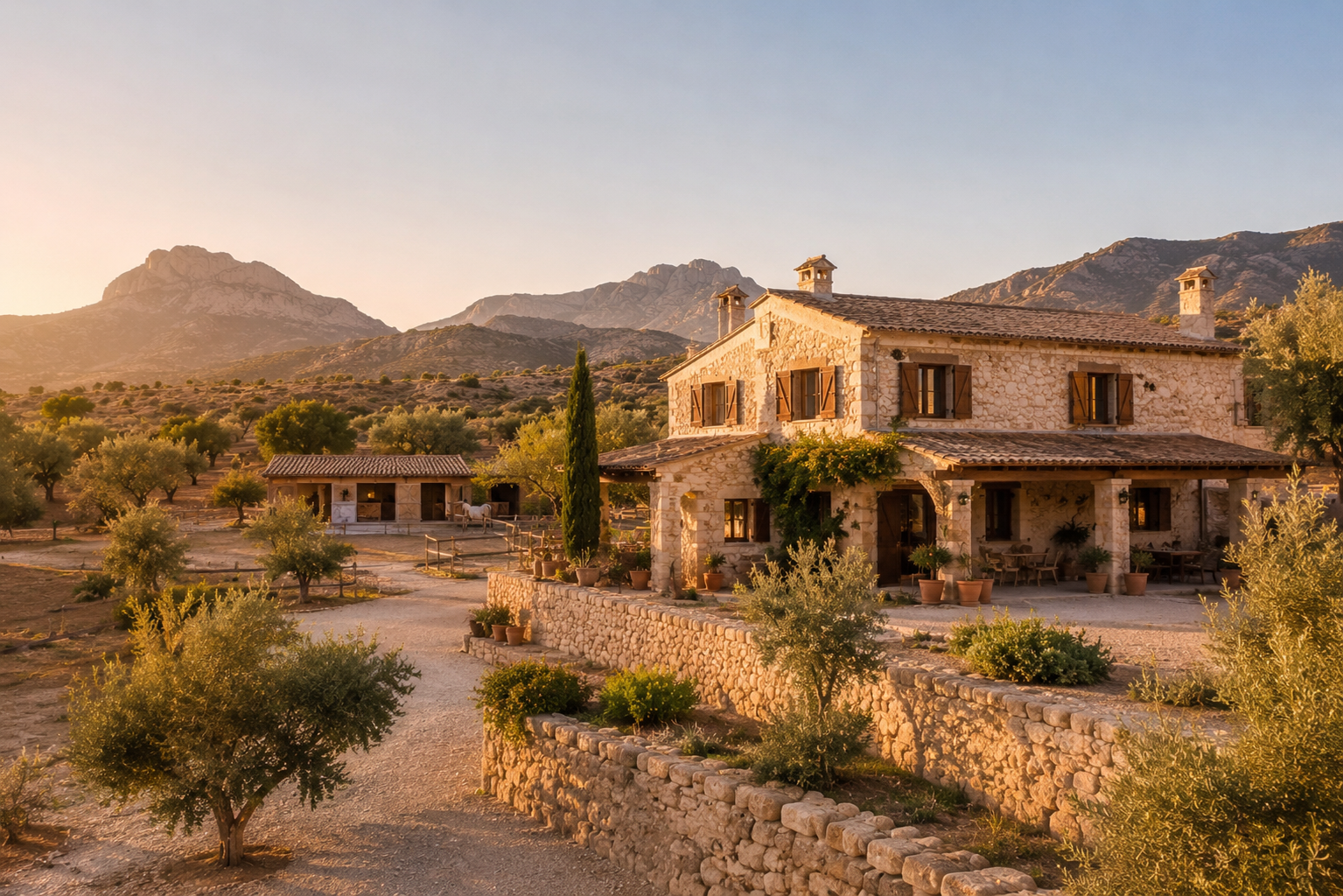
For many people, the idea to build a finca in Spain is not simply a property project. It is a life project. It is the dream of waking up to silence instead of traffic, opening the shutters to the first warm light over almond trees, hearing horses in the paddock, and feeling that rare sense of space that is becoming harder to find in modern life.
On the Costa Blanca, this dream has a very particular beauty. Away from the busy coastal apartments and urbanisations, the inland areas offer a different Spain: dry stone walls, old olive terraces, pine-covered hills, mountain views, wide skies and small country roads leading to plots of rustic land where life feels slower, more private and more connected to nature.
For people who love the countryside, a finca is often the ultimate Spanish dream. It offers independence, privacy, land, animals, gardens, orchards, space for horses, and the possibility of creating a home that truly belongs to the landscape. But building on rustic land in the Costa Blanca is not the same as building on urban land. It is possible in some cases, but it is regulated, technical and slow. The legal framework is strict, the minimum plot size is normally large, and the licence process involves many departments before a building permit can be granted.
This article explains what it means to build a finca on rustic land in the Costa Blanca, what the main legal conditions are, what costs you should expect, what the process looks like, and why, despite the complexity, the result can be one of the most rewarding property investments in Spain.
What is a finca in Spain?
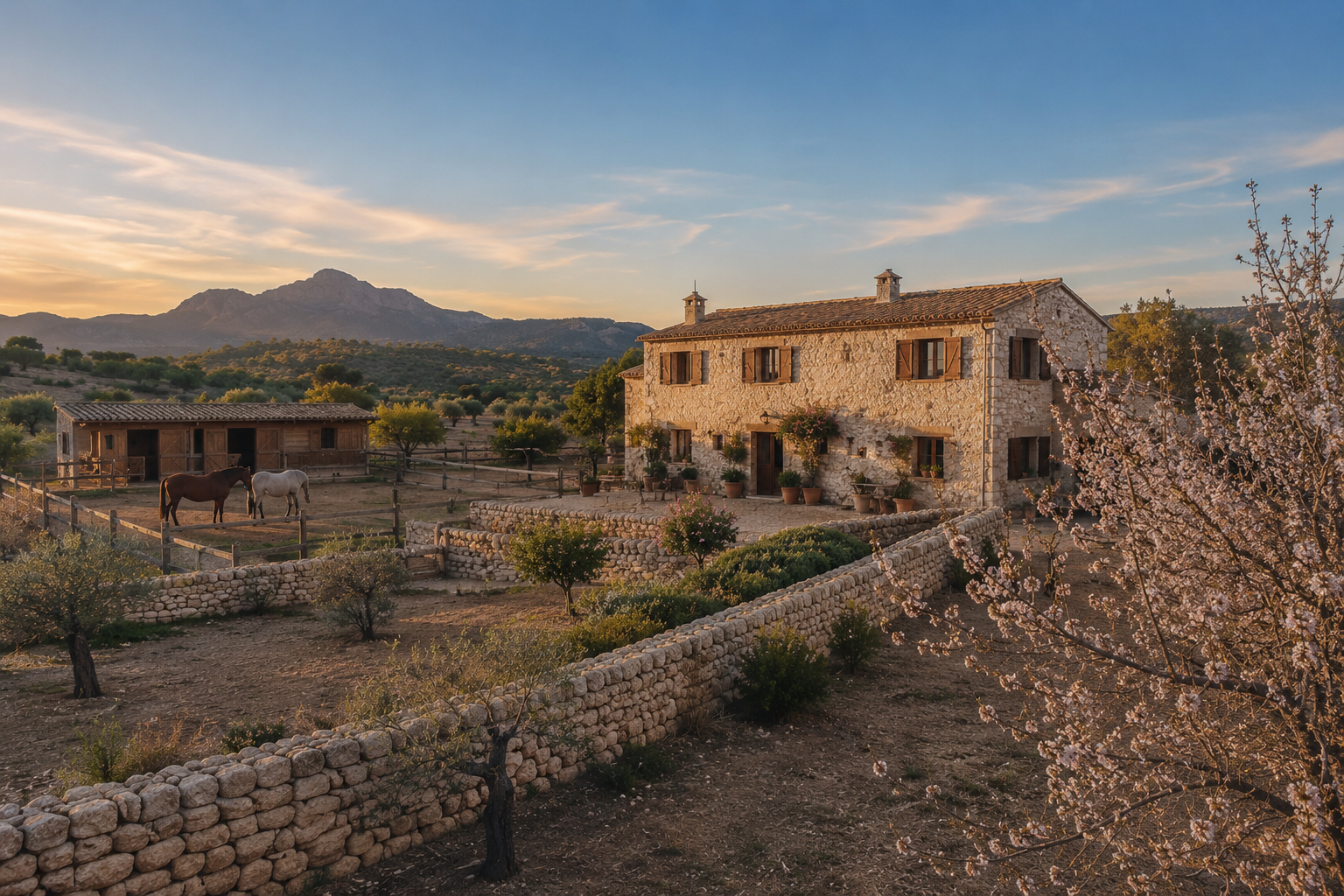
The word “finca” in Spain generally refers to a country property or rural estate. It can mean a plot of land, a rustic house, an agricultural property, or a combination of land and buildings. On the Costa Blanca, when foreign buyers speak about a finca, they often imagine a detached country house with land, privacy and a rural atmosphere.
A finca is different from a villa in an urbanisation. A villa usually stands on urban land or consolidated residential land with roads, pavements, mains water, electricity and a clear building classification. A finca on rustic land is more closely linked to the countryside. It may have agricultural land, uneven access, traditional stone terraces, wells, water deposits, septic systems, solar panels, stables, animal areas and a stronger connection to nature.
This is exactly why many people love it. A finca gives you the feeling of real Spain. You are not surrounded by identical houses. You are not looking directly into the neighbour’s terrace. You can have fruit trees, horses, dogs, chickens, vegetable gardens and outdoor living areas. You can sit outside in the evening and hear nothing but cicadas, birds and the wind through the pine trees.
But that same rural character also explains why the rules are strict. Rustic land is not automatically land for residential construction. In the Valencian Community, including the Costa Blanca, building a new house on rustic land is only possible if the plot and the project meet the applicable planning rules, environmental restrictions and technical requirements.
The basic rule: rustic land is protected from uncontrolled building
The first thing to understand is that rustic land is not urban land. In Spanish planning language, rustic land is often referred to as suelo no urbanizable. The purpose of this classification is to protect agricultural land, natural areas, landscapes, forests, watercourses and rural character.
This does not mean that building is always impossible. But it does mean that building is treated as an exception, not as an automatic right. The project must respect the local planning regulations, the regional rules of the Valencian Community, and any additional restrictions affecting the plot.
In many Costa Blanca municipalities, the general conditions for building an isolated single-family home on rustic land include:
- A minimum plot size, commonly around 10,000 m²
- A maximum building footprint or occupation, often around 2%
- A maximum buildability or constructed area, depending on the local plan
- Minimum distances from plot boundaries, roads, ravines, forests or protected areas
- Legal access to the plot
- Availability of water
- Electricity connection or an approved alternative energy solution
- Wastewater treatment solution, normally a septic tank or modern treatment system
- Compatibility with environmental, landscape, agricultural and fire-prevention rules
The often-mentioned figures of 10,000 m² minimum plot size and 2% footprint are very important, but they must always be checked with the specific town hall and the applicable planning regulations. A plot of 10,000 m² does not automatically guarantee a building licence. The land classification, shape of the plot, access, protected areas, slopes, forest risk, water issues and other factors can still limit or block the project.
Example: what does a 2% footprint mean?
If a rustic plot has 10,000 m² and the local planning rules allow a maximum occupation of 2%, this means the maximum ground footprint may be around 200 m².
That does not always mean you can build exactly 200 m² of house in any form you want. The rules may distinguish between occupation, total constructed area, terraces, porches, pools, auxiliary buildings and agricultural buildings. Some municipalities count covered terraces, pergolas, garages or storage rooms differently. Stables may also be subject to separate rules.
As a simplified example:
A 10,000 m² rustic plot may allow a house with a ground occupation of around 200 m². Depending on the local rules, this could become a comfortable country house with three or four bedrooms, large living spaces, covered terraces and perhaps additional agricultural or equestrian structures if permitted. But the exact design must be prepared by an architect who understands rural planning in the municipality.
The key point is that rustic building projects are not “copy-paste” projects. Every plot must be studied individually.
Why people want to build a finca in Spain
The desire to build a finca in Spain often comes from a very emotional place. It is not only about square metres and price per metre. It is about a lifestyle.
A finca offers privacy. For buyers who are tired of noise, traffic, neighbours, community rules and small plots, rustic land offers breathing space. You can design the house around the sun, the views and the natural rhythm of the land.
It is also ideal for people with horses. On the Costa Blanca, there are many buyers who dream of having their horses at home instead of keeping them at a livery yard. A large rustic plot can offer space for paddocks, stables, feed storage, riding areas and shaded areas, subject to local permissions. The climate also allows for outdoor living with animals during much of the year.
For families, a finca can mean a different kind of childhood: more nature, more freedom, more outdoor activity. For retirees or semi-retired buyers, it can mean peace, gardening, animals and a healthier daily rhythm. For investors, a legally built modern finca can become a scarce product with strong resale value, especially if it combines rustic charm with comfort, energy efficiency and good access.
There is also a deep aesthetic attraction. A well-designed finca does not fight the landscape. It belongs to it. Natural stone, limewashed walls, wooden beams, terracotta, shaded patios, Mediterranean gardens, olive trees, lavender, rosemary and open views create a form of luxury that is quieter and more timeless than many modern coastal developments.

The licence process: why it takes time
One of the most important things to understand is that building a finca on rustic land is not a quick process. A simple reform of an existing property can already take time in Spain. A new build on rustic land is much more complex.
The project normally starts with a detailed study of the land. Before buying the plot, it is essential to check:
- The cadastral information
- The land registry information
- The town planning classification
- The minimum plot size
- Access rights
- Existing constructions, if any
- Water availability
- Electricity availability
- Protected areas
- Flood risk
- Forest fire risk
- Environmental restrictions
- Easements or rights of way
- Distance to roads, ravines or public domain areas
After that, an architect prepares a preliminary project or feasibility study. This is then discussed with the town hall. If the plot appears suitable, the full project can be prepared.
In many cases, the licence process does not stay only with the local town hall. Because the land is rustic, the project may need reports from different departments and authorities. These can include planning, environment, agriculture, water, roads, forestry, fire prevention, landscape protection and sometimes heritage or other specialised departments.
In the Valencian Community, rural building projects may need to pass through regional control, not only municipal control. This is why people often say that the process goes through Valencia. The local town hall may process the file, but different regional departments may need to issue reports before the municipality can grant the building licence.
These reports can cover questions such as:
- Does the plot meet the minimum legal area?
- Is the land protected?
- Is the project compatible with the rural landscape?
- Is there a risk of forest fire?
- Is the plot close to a ravine or watercourse?
- Are there restrictions due to water flow, flood risk or water protection?
- Is the access road legal and safe?
- Is the proposed water supply acceptable?
- Is the wastewater solution acceptable?
- Does the project affect agricultural land, trees or terraces?
- Does the project comply with energy and building regulations?
This can be frustrating for buyers who are used to faster procedures in other countries. But it is also the reason why a legally built finca has value. The licence is not easy to obtain, and once a finca is built legally, it becomes a scarce and protected product.
How long does it take to get a licence?
Timelines vary enormously depending on the municipality, the plot, the complexity of the project and the workload of the authorities. As a realistic expectation, the full process from land study to final building licence can take many months and sometimes more than a year.
A cautious buyer should not approach this as a fast project. It is better to see it as a strategic project. First comes land selection. Then feasibility. Then purchase, if the planning situation is acceptable. Then architectural design. Then licence application. Then waiting for reports, corrections and approvals. Only after the licence is granted should construction begin.
Trying to rush the process or building without the correct licence can create serious legal and financial problems. On rustic land, illegal construction is especially risky. It can lead to fines, demolition orders, inability to register the property correctly, problems with utilities, mortgage issues and future resale problems.
The correct route may be slower, but it protects the value of the investment.
Water: one of the most important points
Water is a crucial issue when building on rustic land. A beautiful plot without a reliable legal water solution may not be suitable for building.
In some rural areas of the Costa Blanca, plots can connect to mains water or to an agricultural water network. In other cases, water may come from a well, a water deposit filled by tanker, or another authorised solution. The acceptability of each option depends on the municipality and the planning requirements.
For a new building licence, the authorities normally want to see that the house will have a legal and sufficient water supply. If the plot cannot connect to mains water, the architect and technical team must explain the proposed alternative.
For buyers who want horses, water becomes even more important. Horses need water daily, and stables, gardens, trees and outdoor areas also increase consumption. A finca lifestyle is beautiful, but it must be planned practically. Water storage, pressure systems, irrigation, filtration and emergency reserves should all be considered from the beginning.
Electricity and off-grid possibilities
Electricity is another key point. Some rustic plots have electricity nearby. Others are far from the grid. Extending the electricity line can be expensive, slow or technically complicated. In some cases, it may require permissions from neighbours or crossing rights.
For this reason, many finca buyers consider an off-grid or semi-off-grid energy solution. On the Costa Blanca, this can work very well because of the climate and the number of sunny days. A modern solar installation with batteries can provide a high level of independence. Combined with efficient appliances, good insulation, heat pumps and intelligent energy management, a rural house can operate with very low running costs.
A typical off-grid or hybrid finca installation may include:
- Solar panels
- Lithium battery storage
- Inverter system
- Backup generator
- Energy-efficient heating and cooling
- Solar hot water or heat pump boiler
- Monitoring system
- Water pump integration
The off-grid dream is attractive because it fits the finca lifestyle: independence, sustainability and freedom. But it must be professionally designed. A country house with air conditioning, pool pump, water pumps, kitchen appliances, office equipment and possibly electric gates or stable equipment needs a serious energy calculation.
In some cases, the authorities may accept an alternative energy project instead of a conventional electricity connection. In other cases, they may still require proof of connection feasibility or technical approval. This must be checked before buying the land.
Access, roads and distance from services
A finca should feel private, but it should not be impractical. Access is a major factor in both licence approval and future value.
A romantic country lane may look charming in summer, but can it handle construction trucks? Is it legally recognised? Is there a right of way? Is it wide enough for emergency vehicles? What happens after heavy rain? Who maintains the road? Is the plot too isolated for daily living?
The best finca plots combine privacy with reasonable access. Ideally, you want countryside silence without being completely disconnected. For most buyers, the ideal balance is a plot that feels rural but is still within 10 to 20 minutes of a town, supermarket, schools, restaurants, beaches and medical services.
On the Costa Blanca, this balance is possible in many inland areas near towns such as Benissa, Teulada, Jalón, Llíber, Alcalalí, Pedreguer, Gata de Gorgos, Orba, Pego, Tárbena, Callosa d’en Sarrià, Polop and other rural zones. Each area has its own character, price level and planning rules.
Rustic land prices on the Costa Blanca
Rustic land prices vary greatly depending on location, views, access, water, electricity, planning possibility and proximity to the coast.
As a broad example, rustic land without building possibility or with difficult access can be relatively cheap. Agricultural land inland may be available from a few euros per square metre. But rustic land that has good access, attractive views, legal water, electricity nearby and realistic building potential is much more valuable.
Indicative examples:
A basic rustic agricultural plot inland with no realistic building possibility might sell for around €3 to €8 per m², depending on the area.
A better located rustic plot with access and some services might range from around €10 to €25 per m².
A highly attractive plot with views, privacy, road access, water possibilities and potential for a legal finca project may go from €25 to €60 per m² or more, especially closer to sought-after coastal towns.
This means that a 10,000 m² plot could cost anywhere from €50,000 to €600,000 or more, depending on the quality of the land and the legal potential. The cheapest plot is not always the best investment. Often, the “cheap” land is cheap because building is not allowed, water is impossible, access is poor, or restrictions are too severe.
For a serious finca project, the value is not in the square metres alone. The value is in the combination of land, legality, access, services, views and planning feasibility.
Building costs for a finca in Spain
Construction costs in Spain have increased in recent years. For a quality new-build country house on the Costa Blanca, a realistic budget should be conservative.
As a general guide, building costs for a modern finca can range from around €1,600 to €2,500 per m² or more, depending on quality, terrain, design, materials, energy systems, pool, terraces, landscaping and technical requirements.
A simple but well-built house may be closer to the lower end. A high-quality finca with natural stone, large windows, energy-efficient systems, underfloor heating, high-end kitchen, pool, stables, landscaping and off-grid technology can easily exceed the upper end.
Example budget:
Land: 10,000 m² rustic plot with good potential: €150,000 to €300,000
House construction: 220 m² x €2,000/m²: €440,000
Architect, technical fees, surveys and licences: €50,000 to €90,000
Pool, terraces and exterior works: €60,000 to €150,000
Solar/battery system: €25,000 to €70,000
Stables and equestrian facilities: €30,000 to €120,000
Landscaping, fencing, gates, water deposits: €40,000 to €120,000
In this example, the total project could easily range from around €800,000 to more than €1,200,000, depending on the ambition and specifications.
At first glance, this may seem high. But compare it with the resale value of a legally built modern finca with land, privacy, views, pool, stables and energy independence. In many areas of the Costa Blanca, this type of property is scarce. Buyers can find many villas in urbanisations, but far fewer legally built modern fincas with serious land and comfort. Scarcity supports value.
Why the value can increase significantly
A rustic plot without a licence is one thing. A legally built finca with all permissions, registered construction, water solution, energy solution and final certificate is something completely different.
The value increase comes from several factors.
First, legal certainty. Buyers pay more for a property that is properly licensed, registered and financeable.
Second, scarcity. It is not easy to create new country houses on rustic land. The process is long and restrictive. This limits supply.
Third, lifestyle demand. More buyers are looking for privacy, land, self-sufficiency, outdoor space and a healthier lifestyle.
Fourth, design quality. A modern finca can offer the best of both worlds: rural character and modern comfort.
Fifth, energy independence. A well-designed solar and battery system can reduce running costs and appeal strongly to international buyers.
Sixth, equestrian potential. A property suitable for horses has a specific market. Buyers with horses often struggle to find legal, practical and attractive homes with enough land.
For these reasons, building a finca in Spain can be both an emotional dream and a strategic investment, provided the legal and technical work is done correctly.
Important risks and mistakes to avoid
The biggest mistake is buying rustic land because it looks beautiful, without checking whether building is legally possible. Never assume that a plot is buildable because it is large. Never rely only on what the seller says. Always verify with an architect, lawyer and the town hall.
Another mistake is confusing cadastral information with planning permission. The catastro may show a plot and even existing buildings, but that does not mean everything is legal or that new building is allowed.
A third mistake is underestimating infrastructure. Water, electricity, access, wastewater, fencing, earthworks and landscaping can cost a lot of money.
A fourth mistake is starting works before the licence is granted. On rustic land, this is especially dangerous.
A fifth mistake is designing a house that does not respect the landscape. A finca should not look like an urban villa dropped into the countryside. The best projects use materials, colours, volumes and landscaping that integrate with the environment.
Finally, some buyers underestimate the emotional side of a long licence process. There may be delays, reports, technical corrections and extra requirements. Patience is essential.
Pros and cons of building a finca in Spain
Pros
Building a finca in Spain gives you privacy, space and a lifestyle that is very difficult to find in urban areas. You can create a home around your own vision, with land, views, gardens, animals, horses and outdoor living. A legally built finca can have strong resale value because it is a scarce product. You can design the property with modern insulation, solar energy, batteries, water systems and low running costs. The result can be a unique home that combines Mediterranean country charm with modern comfort.
Cons
The process to build a finca in Spain is slower and more complicated than building on urban land. Not every rustic plot is buildable. The licence process can involve many departments and take a long time. Infrastructure costs can be high, especially for water, electricity, access and wastewater. Professional advice is essential, and the total investment can be significant. There is also more maintenance: land, trees, fences, pools, stables and access roads all require attention.
Final thought: a dream worth doing properly
To build a finca in Spain is not the easiest route to owning a home on the Costa Blanca. It is not for buyers who want a quick purchase, a standard villa and immediate delivery. It is for people who feel something when they stand on a piece of land and look over the valley. It is for people who understand the value of silence, space, animals, trees and open sky.
Yes, the process takes time. Yes, the rules are strict. Yes, the licence must pass through planning, environmental, forestry, water and other departments. But that is precisely why the final result is so valuable.
A legally built finca on rustic land is more than a house. It is a private world. It is a place where mornings start with light over the mountains, where horses graze near the house, where evenings are quiet, and where the Spanish countryside becomes part of daily life.
For the right buyer, it is not only a property. It is the ultimate Spanish dream.
Join The Discussion