



 by
by 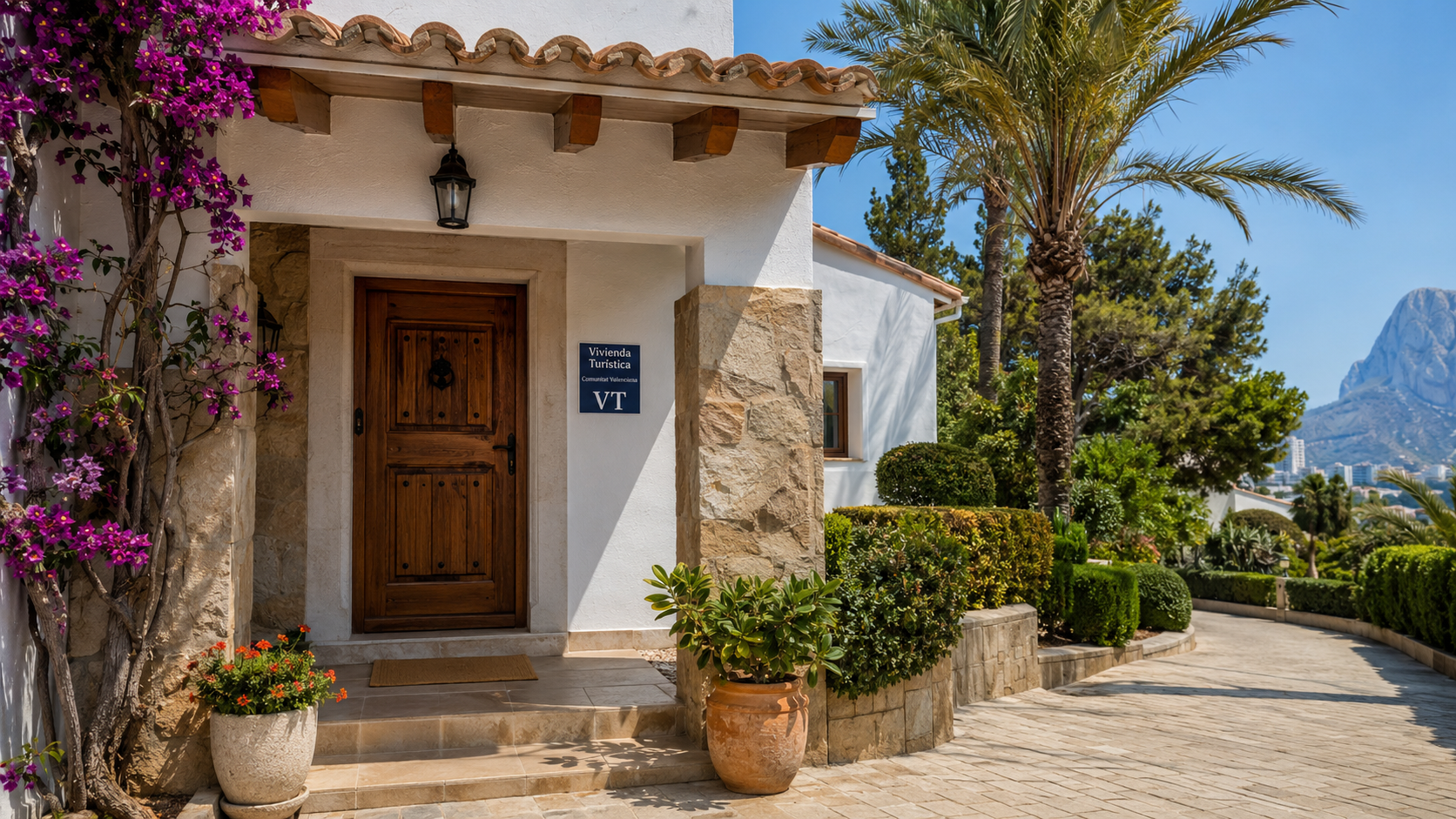
Calpe has long been one of the most attractive destinations on the Costa Blanca for international buyers looking for sun, sea, lifestyle and to buy a villa in Calpe for rental potential. With its Mediterranean climate, the Peñón de Ifach, sandy beaches, marina, restaurants, walking routes and year-round appeal, Calpe remains a strong location for buyers who want both personal use and income from holiday letting.
However, the rules around holiday rentals in Spain, and especially in the Valencian Community, have become more demanding. For investors, this makes property type more important than ever. In the past, many buyers automatically looked at apartments close to the beach because they seemed easy to rent out. Today, however, apartments can face an additional obstacle: the community of owners.
In many apartment buildings, holiday letting is no longer only a question of obtaining a tourist licence or complying with regional regulations. It can also depend on the position of the owners’ community. Under the Spanish Horizontal Property Law, communities of owners may limit or condition tourist rental activity if the required majority is reached. In practice, this can make holiday letting in apartment buildings more uncertain, especially if other owners are concerned about noise, higher use of communal areas, lift traffic, security, or changes in the residential character of the building.
This is one of the main reasons why many buyers are now looking more seriously at detached villas. If you want to buy a villa in Calpe with the idea of using it partly for holiday letting, a villa without a community of owners can offer a more independent and future-proof option.
The changing context for holiday rentals
Holiday rentals have grown strongly across Spain over the last decade. Digital platforms made it easy for private owners to rent their properties to tourists, and demand from international visitors increased significantly. In areas such as Calpe, this created opportunities for owners, but also pressure on housing markets, neighbourhoods and residential communities.
As a result, public authorities have introduced stricter rules. In the Valencian Community, tourist accommodation is regulated at regional level, and properties used for holiday letting must comply with registration, habitability, advertising and operational requirements. Owners must make sure that the property is legally suitable for tourist use, that it has the correct documentation, and that the tourist registration number is used properly in advertising.
At the same time, national legislation has given communities of owners more influence over whether tourist rental activity can take place within their buildings. This means that an apartment may seem attractive from a rental perspective, but the buyer also needs to check whether the building community allows, restricts or may later restrict holiday letting.
Sources for further verification include:
- Spanish Horizontal Property Law: https://www.boe.es/buscar/act.php?id=BOE-A-1960-10906
- Spanish Organic Law 1/2025, which introduced additional legal measures affecting tourist accommodation procedures: https://www.boe.es/buscar/act.php?id=BOE-A-2025-76
- Generalitat Valenciana tourist accommodation information: https://cindi.gva.es/es/web/turisme
- Registro de Turismo Comunitat Valenciana: https://registro.turismo.gva.es/
Why apartments have become more complicated
Apartments can still be excellent properties for personal use or long-term rental. They are often close to beaches, restaurants and services. They can be easier to maintain, and many buyers like the convenience of having communal swimming pools, lifts, gardens and shared maintenance.
For holiday letting, however, apartments now require more caution.
The reason is simple: an apartment is not an isolated property. It forms part of a community of owners. That means the buyer does not only need to consider the property itself, but also the rules, statutes, internal agreements and future decisions of the community.
In many communities, permanent residents may not want holiday rental activity in the building. Their objections can include:
- frequent guest turnover;
- noise in communal areas;
- use of swimming pools and gardens by short-term guests;
- security concerns;
- parties or inappropriate behaviour;
- wear and tear on lifts, hallways and entrances;
- loss of a quiet residential atmosphere.
Because of this, more communities are discussing restrictions. Where the required majority is reached, the community can limit or condition tourist use. Some communities may also impose higher community fees on properties used for holiday letting, within the limits of the law.
For a buyer, this creates uncertainty. Even if an apartment has previously been rented out as a holiday property, that does not automatically mean that the same situation will continue indefinitely. Before buying an apartment for holiday letting, it is essential to check the community statutes, minutes of recent meetings, existing agreements and any pending discussions about tourist rentals.
The 70% community vote issue
One of the key points for buyers is the growing power of communities of owners. The rule commonly discussed is that communities may restrict or condition holiday rental activity if a qualified majority is reached. This is often referred to as a 3/5 majority, which in practical terms represents 60% under the traditional framework of the Horizontal Property Law. Recent legal developments have also increased the need for express community approval in certain situations, and in practice many buyers, owners and administrators now discuss this as a high-majority community decision.

Because rules can be interpreted differently depending on the timing, local practice and the exact legal situation, buyers should always obtain updated legal advice before relying on a holiday rental business model. The key commercial point, however, is clear: apartments depend on the community in a way that detached villas usually do not.
In many communities, the direction of travel is negative for tourist rentals. Owners who live permanently in the building often prefer to avoid short-term rentals. Once the issue is raised in a meeting, it is quite possible that the community will vote against allowing new holiday lets or will impose restrictions that make the activity less attractive.
This is why apartment investments for holiday letting must now be analysed more carefully than before.
Why villas are a stronger option for holiday letting
A detached villa in Calpe offers a different structure. In many cases, a villa does not form part of a traditional apartment-style community of owners. There may be urbanisation rules, municipal regulations, regional tourist rental rules and planning conditions, but there is often no building community that can vote to prohibit tourist letting in the same way as in an apartment block.
This independence is important.

When you buy a villa in Calpe, you are usually buying a property with its own plot, private entrance, private outdoor space and, often, a private swimming pool. Guests do not normally share lifts, hallways, staircases, entrances, gardens or pools with permanent residents. This reduces the typical sources of conflict found in apartment buildings.
For holiday letting, that can be a major advantage. Families and groups often prefer villas because they offer privacy, space and flexibility. They can enjoy the pool, terrace, barbecue area and outdoor living without sharing facilities with dozens of other residents or tourists. This creates a different type of holiday experience and often allows the property to command higher weekly rental prices, especially during the summer season.
Private space is a commercial advantage
Holiday rental guests are increasingly looking for comfort and privacy. A villa can offer exactly that. Instead of a small balcony and communal pool, guests may have several terraces, a private garden, parking, sea views, mountain views or a dedicated outdoor dining area.
This is especially attractive for:
- families with children;
- groups of friends;
- multi-generational holidays;
- remote workers staying for several weeks;
- guests travelling with pets, if allowed;
- visitors who prefer quiet areas over busy apartment blocks.
Calpe has many residential areas that are suitable for this type of rental product, including areas close to the beach, areas with views of the Peñón de Ifach, and quieter urbanisations slightly outside the centre. The variety of villas in Calpe means that buyers can choose between more affordable renovation opportunities, modern villas, Mediterranean-style homes, luxury properties and investment-focused homes with rental potential.
Better control over the guest experience
With an apartment, many parts of the guest experience are outside the owner’s control. The lift, entrance, hallway, communal pool, noise from neighbours, community rules and general maintenance all affect the guest’s impression. Even if the apartment itself is excellent, the review can suffer if guests are unhappy with shared areas.
With a villa, the owner has more direct control. The property, garden, pool, parking, terrace and outdoor furniture all belong to the rental product. This makes it easier to improve presentation, photography, guest satisfaction and reviews.
For holiday letting, reviews are critical. Better reviews lead to higher occupancy, better platform visibility and stronger pricing power. A well-presented villa with professional photos, clear house rules, good air conditioning, fast internet, comfortable beds and a clean pool can perform very well in a market like Calpe.
Higher rental potential in peak season
Calpe’s rental market is strongly seasonal, with high demand in summer and additional demand during Easter, school holidays, cycling season and winter stays from northern European visitors. Villas with private pools are particularly attractive in July and August.
While apartments can rent well, villas often have a higher weekly rental ceiling because they accommodate more people and offer a more complete holiday experience. A three- or four-bedroom villa with pool can be positioned for families and groups who are willing to pay more for privacy and comfort.
This does not mean every villa is automatically a good investment. The purchase price, location, condition, running costs, tourist licence situation, energy efficiency, pool maintenance, cleaning logistics and management costs all matter. But from a strategic point of view, villas can offer more autonomy and better long-term resilience than apartments affected by community restrictions.
The importance of legal due diligence
Buying a villa for holiday letting still requires careful legal checks. A villa is not exempt from regulation simply because it has no community of owners. Buyers should check:
- whether tourist use is permitted;
- whether the property can obtain or already has the correct tourist registration;
- whether the property has a valid licence of occupation or equivalent documentation;
- whether the cadastral and registry descriptions match reality;
- whether extensions, pools or terraces are legal;
- whether there are urban planning issues;
- whether the property complies with safety and habitability requirements;
- whether local or regional rules impose additional conditions.
In the Valencian Community, the tourist rental framework has changed several times and may continue to evolve. Buyers should therefore work with a local lawyer and a real estate agency familiar with the Calpe market.
Useful source links:
- Generalitat Valenciana tourism procedures: https://www.gva.es/es/inicio/procedimientos
- Registro de Turismo Comunitat Valenciana: https://registro.turismo.gva.es/
- BOE Spanish legislation search: https://www.boe.es/buscar/
- Calpe Town Hall: https://www.calp.es/
Why Calpe remains attractive
Calpe offers a combination that is difficult to find in many other destinations. It has beaches, infrastructure, international demand, restaurants, supermarkets, medical services, schools, marinas and natural scenery. It is accessible from Alicante Airport and Valencia Airport, and it attracts buyers and tourists from the Netherlands, Belgium, Germany, France, the United Kingdom, Spain and Scandinavia.
The town has different rental markets. Some guests want to be close to Arenal-Bol beach and the centre. Others prefer La Fossa, the port area, Maryvilla, Canuta, Ortenbach, Cometa, Gran Sol or other residential zones with more space and views. This diversity helps villa owners position their properties for different types of guests.
For buyers looking for both lifestyle and investment, Calpe remains a practical choice. It is large enough to have services all year, but still has a holiday atmosphere. This is important for rental performance outside the strict summer period.
Apartments are not impossible, but they are riskier
This article does not mean that nobody should buy an apartment in Calpe. Apartments can still be suitable for many buyers. They may be ideal for personal holidays, long-term rental, retirement use or lower-maintenance ownership.
However, if the main objective is holiday letting, apartments now require more investigation. The community of owners can become a decisive factor. A buyer should not rely only on historical rental income or the seller’s statement. The legal and community situation must be verified.
Questions to ask include:
- Does the community allow holiday letting?
- Have there been votes or discussions about tourist rentals?
- Are there restrictions in the statutes?
- Are there complaints from neighbours?
- Are holiday rental properties charged extra community fees?
- Could the community vote against holiday rentals in the near future?
- Is the tourist licence transferable or does a new registration need to be requested?
For many investors, this additional uncertainty makes villas more attractive.
Why buy a villa in Calpe now?
The main argument is not only lifestyle. It is control.
When you buy a villa in Calpe, especially a detached villa without a standard owners’ community, you reduce one of the biggest uncertainties now affecting holiday rental investments: the possibility that a community of owners may restrict or oppose tourist letting.
A villa gives the owner more independence, more control over the guest experience, stronger privacy, better positioning for families, and potentially higher rental prices in peak season. It also avoids many of the day-to-day tensions that can occur in apartment buildings where permanent residents and holiday guests use the same communal spaces.
For investors, that difference matters. Regulation is becoming stricter, and the market is becoming more professional. Properties that are legally clear, independent, well located and well managed are likely to be better positioned than properties that depend on uncertain community decisions.
Conclusion
Holiday letting in Calpe is still attractive, but the type of property matters more than before. Apartments may face increasing pressure from communities of owners, especially where residents do not want short-term tourist activity in the building. In the long term, many communities may decide to limit or reject holiday letting, which creates uncertainty for apartment investors.
Detached villas without a traditional community of owners are different. They offer more independence, more privacy, more control and a stronger holiday product. For buyers who want personal use combined with rental income, a villa can be a more secure and flexible option.
For that reason, anyone planning to buy a villa in Calpe for holiday letting should focus on legal due diligence, location, rental appeal, property condition and professional management. With the right property, Calpe continues to offer a strong combination of Mediterranean lifestyle and investment potential.


Join The Discussion